
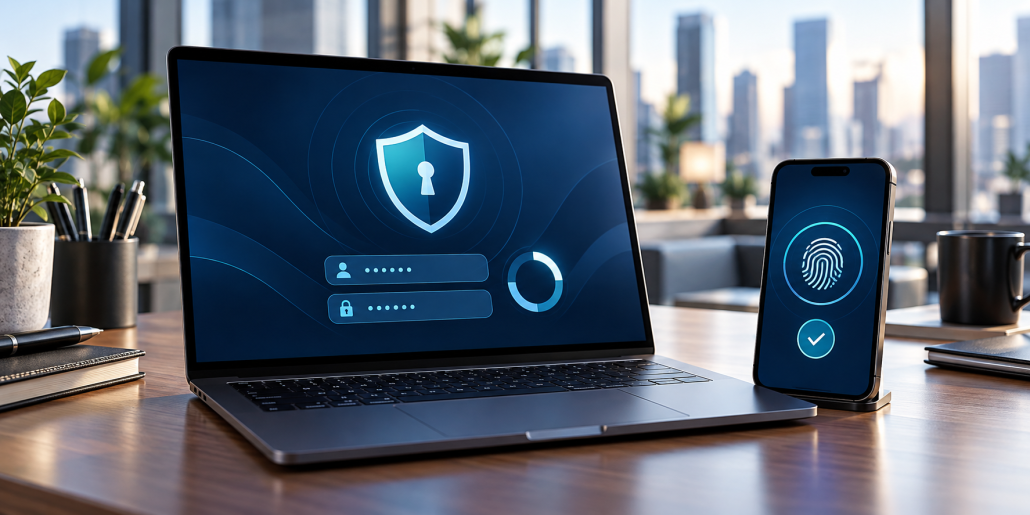
Cybersecurity Isn’t a Product, It’s a Strategy
When most businesses talk about cybersecurity, the conversation usually starts with a product. Maybe it’s Multi-Factor Authentication. Maybe it’s endpoint protection, email security, or backups. Those tools matter.
But there’s no magic bullet solution you can buy once, set, and forget. Modern cybersecurity requires an ongoing practice that brings together technology, people, policies, and planning. As your business changes, your security strategy must evolve with it.
During Cybersecurity Awareness Month, it’s a good time to look beyond the individual products your organization uses and ask a bigger question: Do you have a complete cybersecurity strategy?
Security Requires Multiple Layers
Modern businesses rely on a growing mix of devices, cloud applications, networks, vendors, and remote users. Every connection provides an opportunity to improve productivity but it can also introduce risk.
That’s why effective cybersecurity relies on layers of protection. If one layer fails or is bypassed, another should be there to help stop the threat or limit its impact.
A layered cybersecurity strategy may include:
- Multi-Factor Authentication
- Endpoint protection
- Email security
- Patch management
- Access controls
- Backup and recovery
- Security awareness training
- Threat monitoring
- An incident response plan
Having several security tools is a good start, but simply checking these boxes isn’t enough. The tools need to be selected thoughtfully, configured correctly, monitored consistently, and adjusted as your organization’s needs change.
People Are Part of the Strategy
Employees are often described as the weakest link in cybersecurity. We believe that misses the bigger picture.
The employee who pauses before wiring money to a new account, questions an unusual login request, or calls a vendor to verify a payment change may prevent a costly incident before technology ever needs to step in. Your people can be an important part of your defense.
Security awareness training should help employees recognize suspicious activity and other warning signs they may encounter during a typical workday.
Training should also give employees a clear process for verifying and reporting suspicious activity. They shouldn’t be afraid to ask questions or report a possible mistake. A strong security culture encourages people to slow down, speak up, and help protect the organization.
Technology protects systems, but training protects your business.
Access Deserves Ongoing Attention
Cybersecurity isn’t only about keeping attackers out. It’s also about understanding and controlling who and what already has access to your systems and data.
Consider how quickly access can accumulate. Former employees may still have active accounts. Team members may have permissions they no longer need. Old applications may remain connected to company data. Vendors may have access that was granted for a project but never removed. Employees may also be using unmanaged devices that fall outside your normal security controls.
Regular access reviews help identify these gaps. Your organization should know who can access sensitive data, why they need that access, and whether it is still appropriate.
The goal is not to make work more difficult. It is to give people the access they need while reducing unnecessary exposure.
Your Security Strategy Must Keep Changing
Cybersecurity is not a one-time project because your business does not stand still.
You hire new employees, open locations, introduce applications, replace devices, adopt cloud services, and begin working with new vendors. Your employees may also be using AI tools to search, summarize, create, and analyze information.
Each change can introduce new questions. What data is being shared? Where is it stored? Who can access it? Are the proper safeguards in place?
Threats are evolving too. Phishing emails and social-engineering attacks can now be polished, personalized, and remarkably convincing. Employees can no longer judge a message by appearance alone. They must consider the context: Was the request expected? Is the sender really who they claim to be? Does the requested action make sense?
A complete security strategy accounts for both changes within your organization and changes in the threat landscape.
Preparation Matters as Much as Prevention
Even with strong security measures in place, every organization should be prepared for the possibility of an incident.
An incident response plan establishes what should happen when suspicious activity, data loss, or a security breach occurs. It identifies who needs to be involved, how the threat will be contained, how systems will be recovered, and how employees, clients, or other stakeholders will be informed. Just as important, the plan should be reviewed and tested regularly. A plan that hasn’t been practiced often looks very different when it’s put into action during a real incident.
Reliable backups are also essential, but having backups is only part of the equation. They should be protected, monitored, and tested to confirm that data can actually be restored when it is needed.
The middle of a crisis is not the time to decide who is responsible or discover that a backup cannot be recovered. Preparation helps your team respond with clarity and confidence.
The Value of the Right Technology Partner
Managing cybersecurity requires a view across your entire technology environment, not just one device or security product. A good technology partner looks at the whole picture. They help protect users and devices, manage access, secure cloud environments, strengthen training and policies, and adjust your approach as risks evolve. Just as importantly, they help translate technical issues into practical business decisions.
Cybersecurity isn’t a product. It’s an ongoing practice, and you don’t have to manage it alone. This Cybersecurity Awareness Month, it’s worth taking a step back and asking a simple question: Are your security tools working together as part of a larger strategy?
At CIO Solutions, we help organizations build security strategies that evolve alongside their business.


Leave a Reply
Want to join the discussion?Feel free to contribute!